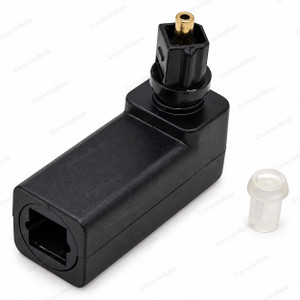
Toslink to 3.5mm Mini Toslink Adaptor — Optical Socket to Plug
A mini Toslink adaptor that lets an ordinary full-size optical cable plug into a 3.5mm optical port.
Check compatibility
Two things worth checking before you order. First, this is digital optical only. It looks like a 3.5mm plug, but it is not an analogue adaptor — it will not carry headphone or aux audio, and it will not turn an analogue socket into an optical one. Second, the direction matters: this is a Toslink socket going to a 3.5mm plug. The opposite part, a 3.5mm socket going to a full-size Toslink plug, looks similar in a photograph and is a different adaptor — if your cable has the small round plug and your device has the big square port, you need that one instead of this one.
Key product details
- Lets a standard full-size Toslink optical cable plug into a 3.5mm mini optical port
- Full-size Toslink (EIAJ) socket at one end, 3.5mm mini Toslink plug at the other
- Passes the digital S/PDIF signal straight through — no power, no drivers, nothing to configure
- Removable clear cap supplied to protect the optical tip when it is not plugged in
- Gold-plated plug barrel resists tarnish and corrosion for a reliable, long-lasting fit
- Suits Mac mini, MacBook Pro, iMac and Mac Pro (2010–2015), AirPort Express, Chromecast Audio, sound cards, mix amps and AV gear with a 3.5mm optical output
- Carries stereo PCM and encoded surround such as Dolby Digital and DTS, exactly as the source device sends it
- Optical only — this is not an analogue headphone or aux adaptor and it passes no analogue audio
- Check the direction — Toslink socket to 3.5mm plug. The opposite part (3.5mm socket to Toslink plug) is a different adaptor
- 12-Month Warranty
About this item
Plenty of gear takes its digital audio out through a 3.5mm socket rather than the big square Toslink connector — Mac minis, MacBook Pros, iMacs and Mac Pros from about 2010 to 2015, AirPort Express, Chromecast Audio, a lot of sound cards and headset mix amps.
This puts a full-size Toslink socket on the end of that port, so the optical lead you already own goes straight in.
One end is a full-size Toslink (EIAJ) socket that takes the standard square optical plug. The other is a 3.5mm mini Toslink plug on a short rigid stem, which pushes into the device the same way a headphone plug would. A clear cap is supplied over the tip and simply pulls off — keep it on the shelf and put it back when the adaptor is not in use, because the exposed optical face is what carries the signal.
It is a completely passive part. There is no power, no switch, no driver and nothing to set up — the S/PDIF signal passes straight through, carrying stereo PCM and encoded surround formats such as Dolby Digital and DTS exactly as the source sends them. Because every optical join costs a little signal, we would suggest keeping the total cable run sensible rather than chaining adaptors.