PAL Plug to F Type Socket Adaptor — TV Aerial / Antenna to F Screw Coax
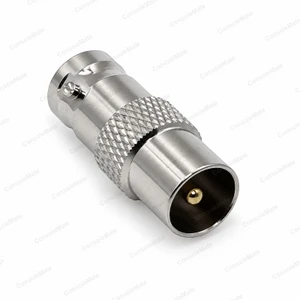
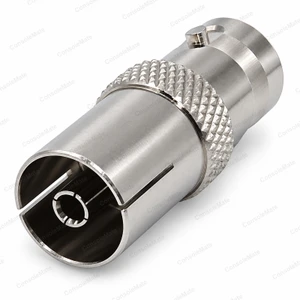
This is the small rigid adaptor that lets a coaxial cable terminated with a screw-on F connector feed a television or set-top box whose aerial input is the ordinary Australian PAL socket. One end is a PAL plug — the plain barrel with a single pin standing proud in the middle — and the other is an F socket, the externally threaded barrel closed by a white insulating disc with a small hole through the centre. Screw your cable onto the threaded end and push the other end into the aerial socket.
Key product details
- PAL (Belling-Lee) MALE plug on one end, F-TYPE FEMALE screw socket on the other. The PAL end pushes into an aerial socket; the F end accepts the screw-on F connector already fitted to your coaxial cable
- Lets coax that has been terminated with an F connector — satellite, pay-TV, MATV or any RG6 run — feed a television, set-top box or wall plate that only takes the ordinary push-fit aerial plug, without cutting or re-terminating anything
- The usual reason people buy it: a dish, LNB or head-end lead finishes in a screw-on F connector, and the equipment at the other end has the standard Australian PAL aerial socket
- One-piece rigid adaptor — no cable, no lead, nothing to power and nothing to configure. It simply changes the connector
- Silver metal body, with a knurled centre grip band so the F connector can be done up finger-tight without pliers
About this item
The job it does most often is bringing a satellite, pay-TV or shared-antenna feed into ordinary television equipment. Coax used for those installations is nearly always terminated with an F connector, because it screws up tight and stays put, while televisions, video recorders, set-top boxes and wall plates sold in Australia take a PAL plug. This adaptor bridges the two without re-terminating the cable. It is equally at home on a bench, where an F-terminated patch lead needs to reach a tuner that only offers the push-fit socket.
The PAL end is a plug and the F end is a socket. The PAL end is the plain barrel with the small pin in the centre, and it goes into the aerial socket on your equipment. The F end is the threaded barrel with the white disc, and the connector already fitted to your coax does up onto it. If you hold your cable in one hand and look at the last connector on it, this adaptor is the right one when that connector is a male F fitting with a thread and a fine centre wire, and the thing you are trying to reach has a push-fit aerial socket.
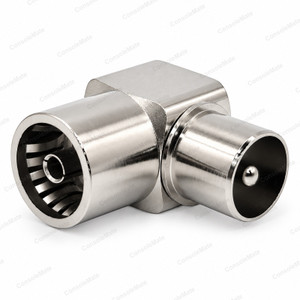
Please check you want this gender. Four adaptors in this family look almost identical in a photograph. This listing is PAL MALE to F FEMALE. If what you need is the opposite — an F plug to screw into an F socket on a wall plate, splitter or dish, with a PAL socket to accept an aerial lead — we sell that part too — look for our F Type Plug to PAL Socket adaptor, because it is a different part and this one will not do the job. All-socket and all-plug versions exist as well. Quickest check from the photographs: the threaded end with the white disc is the F socket, and the plain end with the pin is the PAL plug.
Check these alternatives
Need the opposite genders? See our F-type male plug to PAL female socket adapter. Compare both ends before ordering.
Choose only what your setup needs. Linked items are sold separately.
One honest limitation. Most competing listings advertise “75Ω”. Our supplier does not specify an impedance for this part, so we will not print a figure we cannot stand behind. For television, antenna, satellite and general AV work the distinction makes no practical difference at these frequencies. If you are doing laboratory or instrumentation work where a specified impedance genuinely matters, buy an adaptor sold with a stated figure.